
Certificates of Analysis
Independent third-party testing for this product. Tap a report to view the data.
Semax (10mg) — ACTH(4-10) Analogue Nootropic Research Peptide
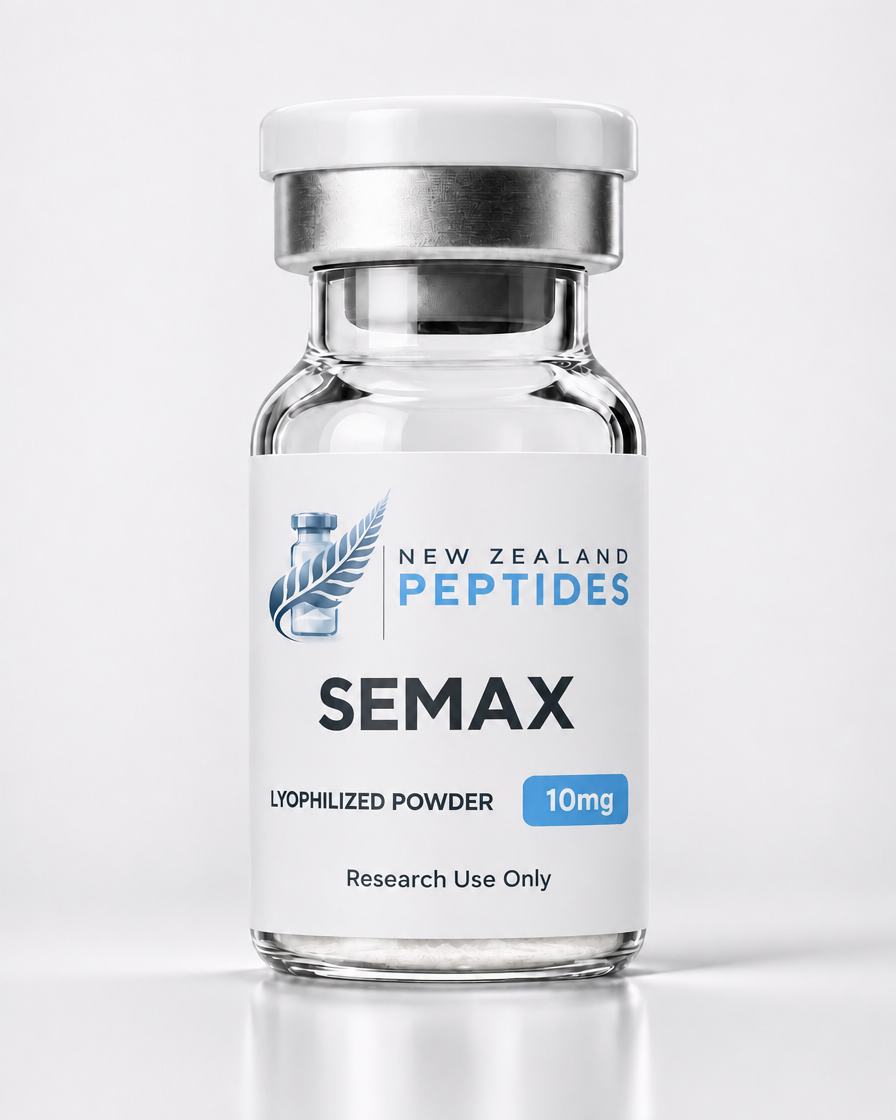
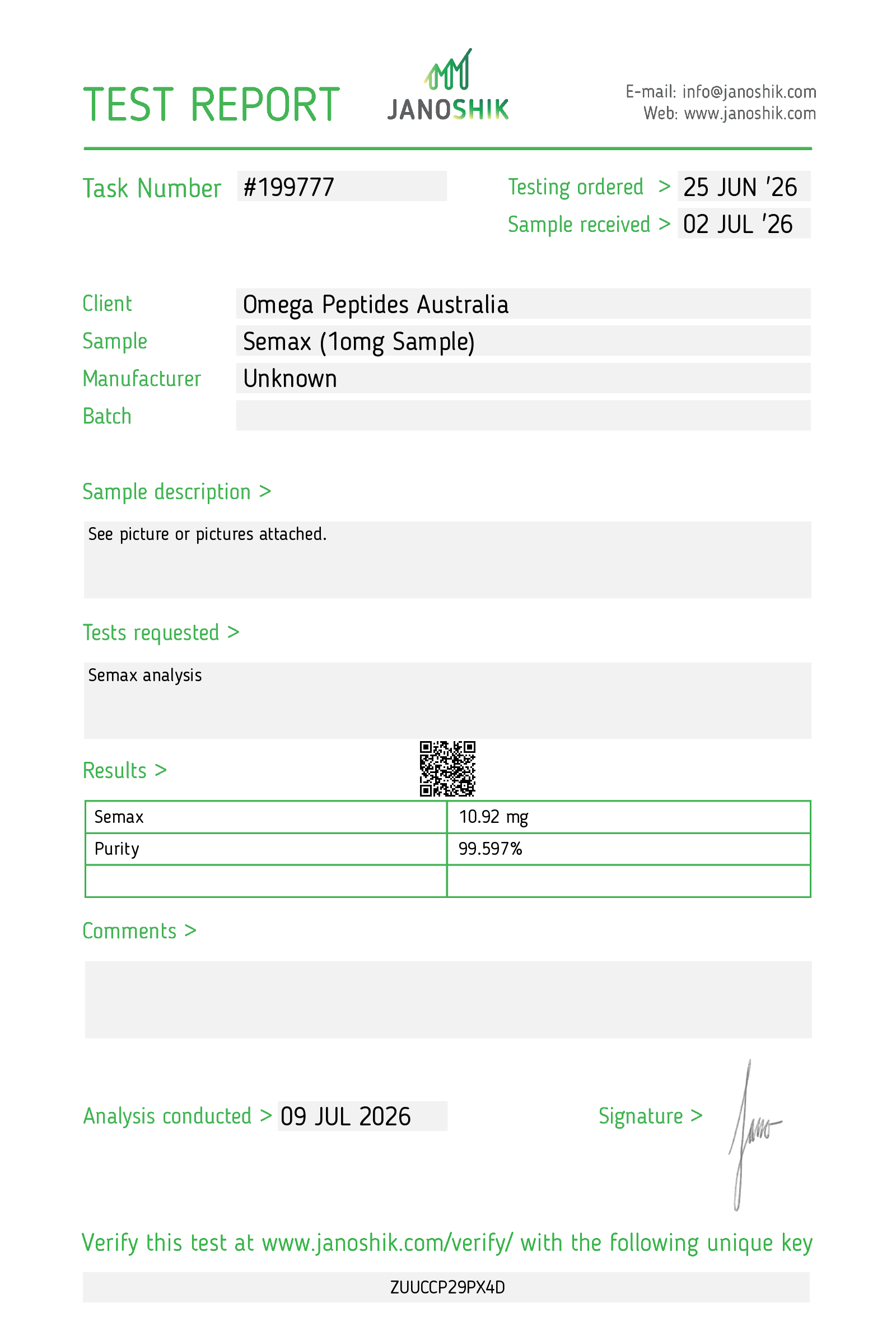
New Zealand Peptides supplies Semax (10mg) in New Zealand, dispatching same day on orders placed before 12pm with a certificate of analysis published for every batch. Often written semax peptide, se max or ACTH 4-10 analogue, it is a synthetic ACTH fragment analogue studied for BDNF expression and neuroprotection. The current batch (#199777) was tested by Janoshik Analytical on 9 July 2026 at 99.6% purity by HPLC.
Semax is a synthetic heptapeptide developed at the Institute of Molecular Genetics of the Russian Academy of Sciences and first described in the scientific literature in 1991. Its sequence, Met-Glu-His-Phe-Pro-Gly-Pro, joins the 4 to 7 fragment of adrenocorticotropic hormone (ACTH) to a C-terminal Pro-Gly-Pro tail, which is why it is classified as an ACTH(4-10) analogue. Unlike the parent hormone it has no steroidogenic activity: the fragment was selected for the effects on attention and memory seen in early animal work, and the Pro-Gly-Pro extension was added to slow enzymatic breakdown. The compound is often written as se max, semax peptide or by its one-letter sequence MEHFPGP.
Semax is studied in three main directions: cognition and memory, neuroprotection in cerebral ischaemia models, and stress and attention research. At the pathway level it rapidly raises the expression of brain-derived neurotrophic factor (BDNF) and its receptor TrkB in the hippocampus, interacts with melanocortin receptors, and inhibits the enzymes that degrade enkephalins, so several signalling systems are engaged at once rather than a single receptor.
New Zealand Peptides supplies Semax as a high-purity (≥99% HPLC) COA-verified lyophilised powder in a sealed 10mg vial. Orders placed before 12pm are dispatched the same day, and the batch Certificate of Analysis for every lot is published in our COA library.
Key research areas
- Neurotrophin signalling Rodent studies have shown that Semax increases BDNF protein and TrkB receptor expression in the hippocampus within hours of administration. Because BDNF supports synaptic plasticity and neuronal survival, this is the most frequently proposed explanation for the cognitive findings reported with the peptide.
- Cerebral ischaemia and neuroprotection In rat models of focal ischaemia Semax has been investigated for its influence on neuronal survival and on the expression of genes involved in inflammation, vascular response and neurotransmission in the affected tissue. In Russia the peptide is registered as a nasal solution and has been used in the clinical management of ischaemic stroke, which is where much of this literature originates.
- Learning, memory and attention Behavioural studies in rodents have examined acquisition and retention in passive-avoidance and maze tasks. The ACTH(4-10) fragment was already known to influence attention, and Semax was designed to preserve that activity while lasting considerably longer in tissue.
- Monoamine neurotransmission Semax has been reported to alter dopamine and serotonin turnover in the striatum and hypothalamus of rodents, a finding that connects the peptide to research on attention, motivation and mood-related behaviour.
- Enkephalin and stress systems In vitro, Semax inhibits enkephalin-degrading enzymes in human serum. Because enkephalins modulate pain and stress responses, this observation is used to explain the anxiolytic-like behaviour seen in some animal models, and it links Semax mechanistically to Selank, which shares the same Pro-Gly-Pro tail.
- Optic nerve and retinal research Semax has also been studied in models of optic nerve damage and retinal degeneration, where its neurotrophic and anti-inflammatory actions on neural tissue are the focus of investigation.
Semax in New Zealand
Semax is supplied in New Zealand strictly as a research-grade lyophilised vial; it is not a registered medicine and is not available through Chemist Warehouse, Unichem or compounding pharmacies. New Zealand Peptides holds it in stock, dispatches same day on orders before 12pm, and ships on tracked delivery within New Zealand. Each batch carries an independent certificate in the COA library matched to the number printed on the vial. Browse the full range of research peptides in New Zealand on our homepage.
Semax is available in New Zealand as a lyophilised 10mg vial; searches for Semax nasal spray in New Zealand refer to a delivery format researchers prepare from the same lyophilised material. The acetylated form N-Acetyl Semax and the companion anxiolytic Selank are also held in stock, as is the Semax + Selank bundle.
How Semax works
Semax does not act through a single receptor. Its N-terminal Met-Glu-His-Phe segment is the core of ACTH(4-10) and is recognised by melanocortin receptors; Semax has been reported to competitively antagonise alpha-melanocyte-stimulating hormone at MC4 and MC5 receptors rather than to act as a classical agonist, and it has no effect on cortisol production. Downstream, the peptide increases BDNF and TrkB expression in the hippocampus, shifts monoamine turnover and inhibits enkephalin-degrading enzymes. The result is a compound that is studied for a neurotrophic and neuromodulatory profile rather than a hormone-like one.
Pharmacokinetically, the native ACTH(4-10) fragment is broken down within minutes. The Pro-Gly-Pro tail of Semax slows this degradation and extends the period of biological activity to hours, although the intact peptide still has a short plasma half-life and is progressively trimmed from the N-terminus into shorter fragments such as Glu-His-Phe-Pro-Gly-Pro, some of which retain activity of their own. This is the main distinction from N-Acetyl Semax, in which an acetyl group caps the N-terminal methionine to block aminopeptidase cleavage and extend stability further.
Specifications
| Compound | Semax |
| Also known as | Semax peptide, se max, ACTH(4-7)-Pro-Gly-Pro, MEHFPGP, ACTH 4-10 analogue |
| CAS number | 80714-61-0 |
| Molecular formula | C₃₇H₅₁N₉O₁₀S |
| Molecular weight | 813.9 g/mol |
| Sequence | Met-Glu-His-Phe-Pro-Gly-Pro (MEHFPGP) |
| Category | Nootropic research |
| Purity | 99.6% by HPLC · content 10.92 mg · Janoshik Analytical batch #199777 (9 July 2026) · verify report |
| Form | Lyophilised powder in a sealed sterile vial |
| Vial sizes available | 10mg — $79.99 |
| Storage (lyophilised) | 2–8°C short term or −20°C long term, protect from light and moisture, avoid repeated freeze-thaw |
| Storage (reconstituted) | 2–8°C, use within 28 days |
| Reconstitution | Bacteriostatic water (recommended) |
Available sizes and pricing
Semax is supplied in a single 10mg vial. For projects that pair it with Selank, the Semax and Selank Bundle combines both peptides with bacteriostatic water, syringes and swabs at a lower combined cost than buying each item on its own.
- 10mg vial — $79.99 (about $8.00 per mg)
Multi-vial pricing (10mg): 2 vials $143.98 (10% off, $71.99 each), 3 vials $209.97 (12.5% off, $69.99 each), 4 vials $271.97 (15% off, $67.99 each). The discount is applied automatically in the cart.
Quality and COA verification
Every batch of Semax is tested independently by Janoshik Analytical. HPLC is used to quantify purity and mass spectrometry to confirm that the measured molecular mass matches the expected value for the Met-Glu-His-Phe-Pro-Gly-Pro sequence, so identity and purity are verified separately. A Certificate of Analysis is issued for each batch and published in our COA library, which means the lot number on a vial can be matched to its own report before the vial is opened. The peptide is supplied as a lyophilised powder in a sealed sterile vial, a format that protects it from hydrolysis and oxidation during storage and transit, and every order is packed with protective cushioning for delivery within New Zealand.
Frequently bought together
- Bacteriostatic Water (10mL) — $29.99, the recommended diluent for reconstituting lyophilised Semax
- Selank (10mg) — $79.99, the tuftsin-derived companion peptide studied alongside Semax in anxiety and cognition models
- N-Acetyl Semax (10mg) — $129.99, the acetylated analogue for stability comparison work
- Semax and Selank Bundle — $169.99, both peptides with lab supplies in one kit
Research guides
- Semax New Zealand research guide
- Peptide storage guide: how to store lyophilised peptides properly
- COA testing explained for research peptides
- Peptide reconstitution calculator
Frequently asked questions
What is Semax?
Semax is a synthetic seven-amino-acid peptide (Met-Glu-His-Phe-Pro-Gly-Pro) built from the 4 to 7 fragment of adrenocorticotropic hormone with a Pro-Gly-Pro tail added for stability. It was developed at the Institute of Molecular Genetics in Moscow and is studied as a nootropic and neuroprotective research compound in models of memory, attention and cerebral ischaemia. New Zealand Peptides supplies it as a lyophilised 10mg research vial for in-vitro laboratory use only.
What is Semax also known as?
It is most often written simply as Semax, but also appears as se max, semax peptide or Semax 10mg. In the chemical literature it is described as an ACTH(4-10) analogue, ACTH(4-7)-Pro-Gly-Pro or by its one-letter sequence MEHFPGP, and its CAS number is 80714-61-0. The acetylated derivative sold separately is N-Acetyl Semax, often shortened to NA-Semax, which is a different compound with its own specifications.
How does Semax work?
Semax engages several systems rather than one receptor. It increases BDNF and TrkB expression in the hippocampus, interacts with melanocortin receptors (reported as a competitive antagonist of alpha-MSH at MC4 and MC5 with no effect on cortisol), alters dopamine and serotonin turnover, and inhibits enkephalin-degrading enzymes. The Pro-Gly-Pro tail slows enzymatic breakdown, so the peptide remains active in tissue for hours rather than the minutes typical of the native ACTH fragment.
What does the research show about Semax?
Most published work comes from Russian laboratories and rodent models. It reports increased hippocampal BDNF, improved acquisition and retention in learning tasks, reduced neuronal loss and altered gene expression in ischaemia models, and anxiolytic-like behaviour under stress. In Russia the peptide is registered as a nasal solution and appears on the national list of essential medicines. Outside that setting the evidence remains preclinical, and no New Zealand regulator has evaluated the compound for any use.
Can I buy Semax at Chemist Warehouse or a pharmacy in New Zealand?
No. There is no Semax product approved as a medicine in New Zealand, so Chemist Warehouse, Unichem and other retail pharmacies do not stock it. The lyophilised Semax supplied by New Zealand Peptides is a research-grade chemical intended for laboratory work, which is a different category of product from a medicine dispensed by a pharmacist.
Can New Zealand compounding pharmacies supply Semax?
Compounding pharmacies in New Zealand may only prepare a medicine for an individual patient against a valid prescription. Semax is not an approved medicine here, so it is not a routine compounding item. Research suppliers such as New Zealand Peptides provide the lyophilised research compound, which is a different product intended for in-vitro work rather than for dispensing.
How do you reconstitute Semax?
Allow the vial to reach room temperature, then add bacteriostatic water slowly down the inside wall of the vial rather than directly onto the powder. Swirl gently until the solution is clear; do not shake, because agitation can damage peptide bonds. The volume of diluent depends on the concentration the research design requires, and our reconstitution calculator can assist with that arithmetic. Refrigerate the reconstituted solution at 2–8°C and use it within 28 days.
How should Semax be stored?
Keep the lyophilised powder sealed at 2–8°C for short-term storage or at −20°C for long-term storage, away from light and moisture. Avoid repeated freeze-thaw cycles, which degrade peptides over time. Once reconstituted with bacteriostatic water the solution should be kept refrigerated at 2–8°C and used within 28 days. Semax contains a methionine residue that is susceptible to oxidation, so minimising air and light exposure is particularly relevant for this peptide.
Where can I buy Semax in New Zealand?
Semax 10mg is available directly from New Zealand Peptides. Orders placed before 12pm are dispatched the same day, and every batch is supported by an independent Certificate of Analysis you can check before ordering. Semax sits within our broader research peptides collection alongside Selank, N-Acetyl Semax and the other nootropic research compounds we carry.
What does Semax cost in New Zealand?
Semax is $79.99 for a 10mg vial from New Zealand Peptides, which works out to about $8.00 per mg. The Semax and Selank Bundle is $169.99 and includes one 10mg vial of each peptide plus 10mL bacteriostatic water, insulin syringes and alcohol swabs, lowering the combined cost compared with purchasing each item individually. All pricing is in New Zealand dollars, and tracked shipping is calculated at checkout.
How do I get Semax online in New Zealand?
Open the Semax product page, select the 10mg vial, add it to your cart and complete checkout. Orders are shipped with tracked delivery in discreet, unbranded packaging that gives no indication of the contents. Orders placed before 12pm on a business day are dispatched the same day, and later orders leave on the next business day. Tracking details are emailed as soon as the parcel is lodged with the carrier.
Is Semax legal in New Zealand?
New Zealand Peptides supplies Semax strictly for lawful in-vitro laboratory research. It is not approved by Medsafe for human or veterinary use and is not sold as a medicine or supplement. Purchasers are responsible for ensuring their intended use complies with all applicable laws. This research-only condition applies to every compound in our catalogue and is stated on each product page and on the COA documentation.
Semax vs N-Acetyl Semax: what does the acetyl modification change?
N-Acetyl Semax carries an acetyl group on the N-terminal methionine of the same Met-Glu-His-Phe-Pro-Gly-Pro sequence. The cap blocks the aminopeptidases that would otherwise trim Semax from the N-terminus, so the acetylated form is more resistant to enzymatic degradation and is expected to persist longer in biological samples. The receptor and neurotrophin targets are the same, and most of the primary literature concerns unmodified Semax. Researchers comparing the two can view the N-Acetyl Semax page for its specifications.
Is Semax available in New Zealand?
Yes, as a research-grade lyophilised peptide from research suppliers. It is not a registered medicine in New Zealand. New Zealand Peptides holds Semax 10mg in stock, COA verified, with same-day dispatch before 12pm.
Can you get Semax in New Zealand?
Yes, from a New Zealand research peptide supplier with stock. New Zealand Peptides dispatches Semax and N-Acetyl Semax on tracked delivery.
What is the tested purity of Semax?
The current batch (#199777) was tested by Janoshik Analytical on 9 July 2026: 99.6% purity by HPLC with 10.92 mg content per vial. The report can be checked on Janoshik’s verification portal using the batch number, and the certificate is published in our COA library.
⚠ For in-vitro research and laboratory use only. Not for human or veterinary use.